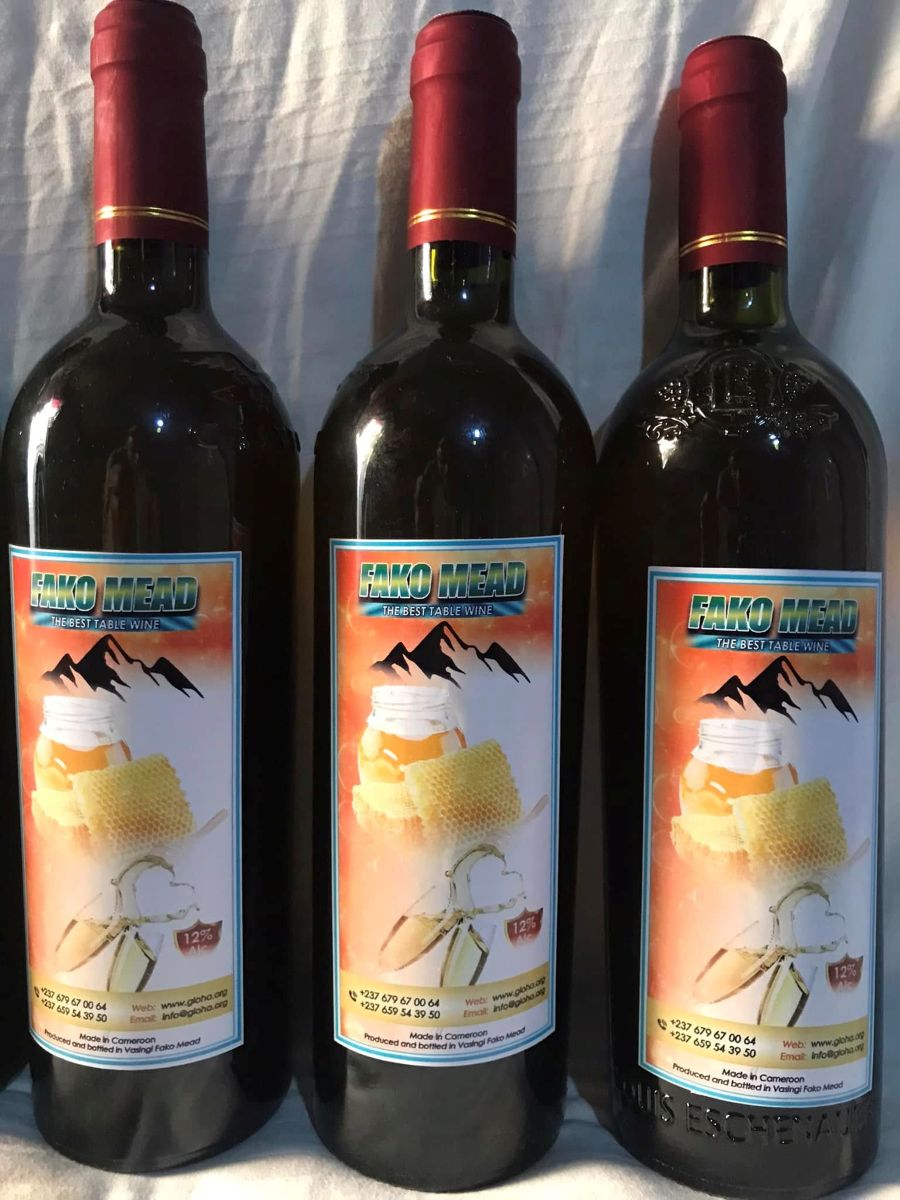
Fako Mead was recently featured in an article and interview by Sarah Nduma Ewumbua in Cameroon Business Today (13-19 May 2026). We reprint them here.
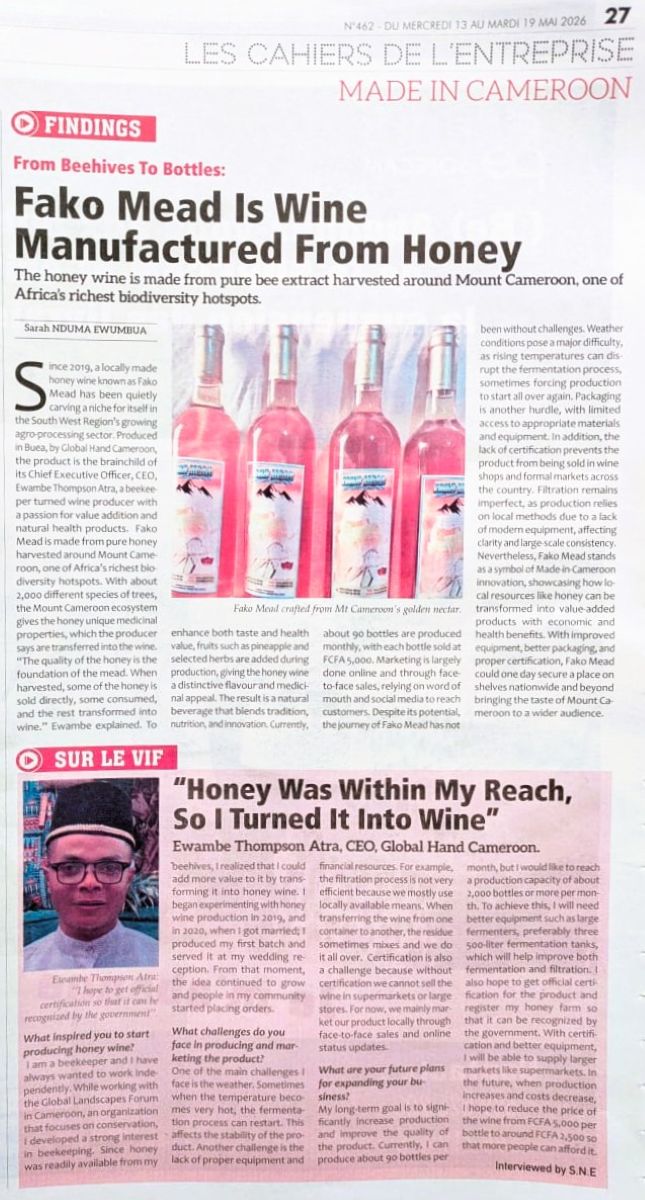
From Beehives to Bottles: Fako Mead is Wine Manufactured from Honey
The honey wine is made from pure bee extract harvested around Mount Cameroon, one of Africa’s richest biodiversity hotspots.
Sarah Nduma Ewumbua, Cameroon Business Today, 13-19 May 2026
Since 2019, a locally made honey wine known as Fako Mead has been quietly carving a niche for itself in the South West Region’s growing agro-processing sector. Produced in Buea by Global Hand Cameroon, the product is the brainchild of its Chief Executive Officer, CEO, Ewambe Thompson Atra, a beekeeper turned wine producer with a passion for value addition and natural health products.
Fako Mead is made from pure honey harvested around Mount Cameroon, one of Africa’s richest biodiversity hotspots. With about 2,000 different species of trees, the Mount Cameroon ecosystem gives the honey unique medicinal properties, which the producer says are transferred into the wine. “The quality of the honey is the foundation of the mead. When harvested, some of the honey is sold directly, some consumed, and the rest transformed into wine,” Ewambe explained. To enhance both taste and health value, fruits such as pineapple and selected herbs are added during production, giving the honey wine a distinctive flavour and medicinal appeal. The result is a natural beverage that blends tradition, nutrition, and innovation.
Currently, about 90 bottles are produced monthly, with each bottle sold at FCFA 5,000. Marketing is largely done online and through face-to-face sales, relying on word of mouth and social media to reach customers.
Despite its potential, the journey of Fako Mead has not been without challenges. Weather conditions pose a major difficulty, as rising temperatures can disrupt the fermentation process, sometimes forcing production to start all over again. Packaging is another hurdle, with limited access to appropriate materials and equipment. In addition, the lack of certification prevents the product from being sold in wine shops and formal markets across the country. Filtration remains imperfect, as production relies on local methods due to a lack of modern equipment, affecting clarity and large-scale consistency.
Nevertheless, Fako Mead stands as a symbol of Made-in-Cameroon innovation, showcasing how local resources like honey can be transformed into value-added products with economic and health benefits. With improved equipment, better packaging, and proper certification, Fako Mead could one day secure a place on shelves nationwide and beyond bringing the taste of Mount Cameroon to a wider audience.
 On the Spot: “Honey was within My Reach, So I Turned It Into Wine”
Ewambe Thompson Atra, CEO, Global Hand Cameroon
Interviewed by Sarah Nduma Ewumbua, Cameroon Business Today, 13-19 May 2026
What inspired you to start producing honey wine?
I am a beekeeper and I have always wanted to work independently. While working with the Global Landscapes Forum in Cameroon, an organization that focuses on conservation, I developed a strong interest in beekeeping. Since honey was readily available from my beehives, I realized that I could add more value to it by transforming it into honey wine. I began experimenting with honey wine production in 2019, and in 2020, when I got married, I produced my first batch and served it at my wedding reception. From that moment, the idea continued to grow and people in my community started placing orders.
What challenges do you face in producing and marketing the product?
One of the main challenges I face is the weather. Sometimes when the temperature becomes very hot, the fermentation process can restart. This affects the stability of the product. Another challenge is the lack of proper equipment and financial resources. For example, the filtration process is not very efficient because we mostly use locally available means. When transferring the wine from one container to another, the residue sometimes mixes and we do it all over. Certification is also a challenge because without certification we cannot sell the wine in supermarkets or large stores. For now, we mainly market our product locally through face-to-face sales and online status updates.
What are your future plans for expanding your business?
My long-term goal is to significantly increase production and improve the quality of the product. Currently, I can produce about 90 bottles per month, but I would like to reach a production capacity of about 2,000 bottles or more per month. To achieve this, I will need better equipment such as large fermenters, preferably three 500-liter fermentation tanks, which will help improve both fermentation and filtration. I also hope to get official certification for the product and register my honey farm so that it can be recognized by the government. With certification and better equipment, I will be able to supply larger markets like supermarkets. In the future, when production increases and costs decrease, I hope to reduce the price of the wine from FCFA 5,000 per bottle to around FCFA 2,500 so that more people can afford it.